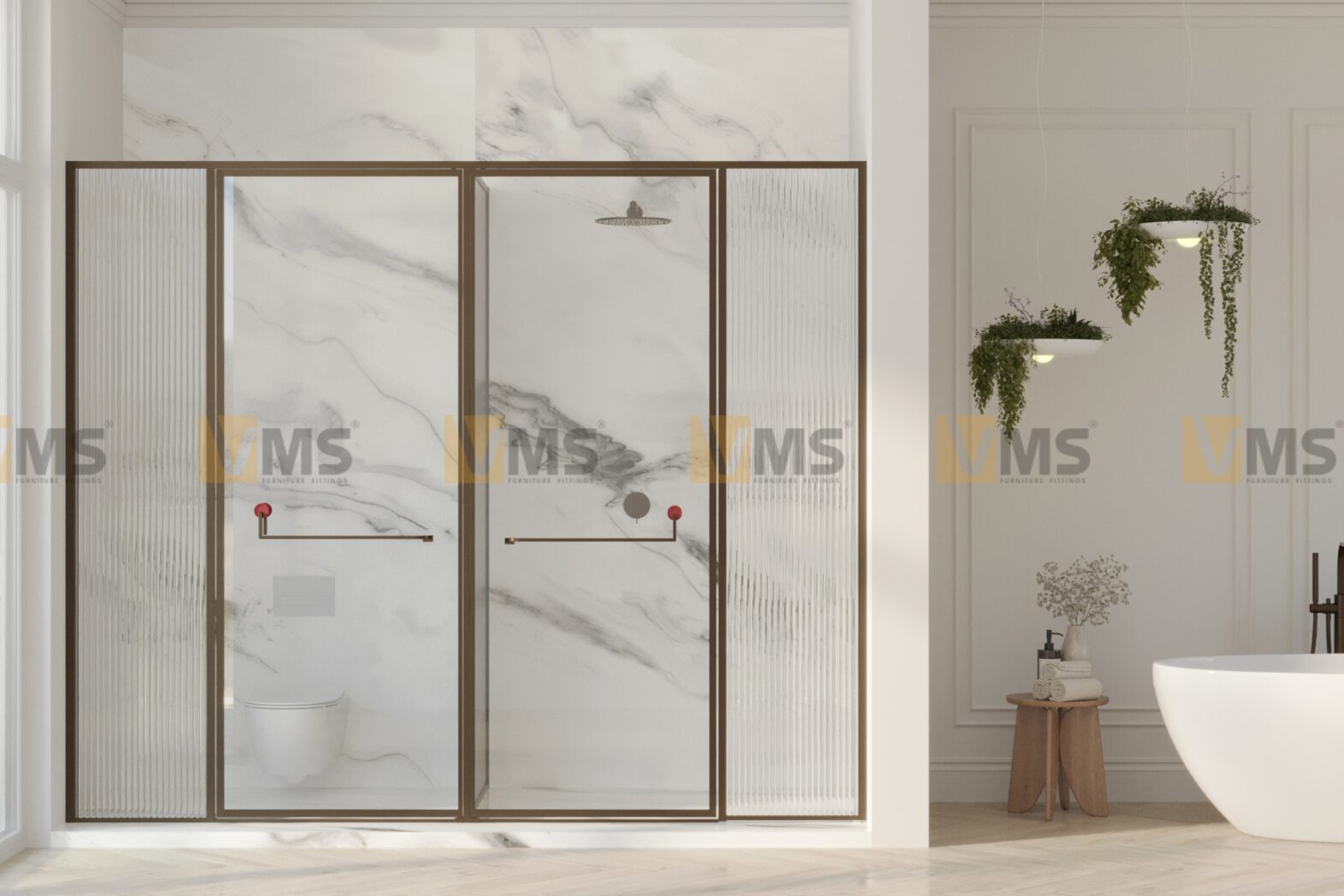

A pivot door shower enclosure is a glass shower door that swings open on a hinge fixed at the top and bottom, rather than sliding along a track. The result is an unbroken glass face with no bottom rail, which keeps sightlines clean and makes the bathroom read as one continuous space instead of a room divided into wet and dry halves.
That single design decision – no track – is what makes pivot enclosures the current preference in premium Indian bathrooms.
What makes a pivot door different from a sliding door?
A sliding shower door runs on a rail. That rail sits at the bottom of the enclosure, and it collects everything: soap scum, hair, hard water deposits. Anyone who has scrubbed a shower track with an old toothbrush knows exactly what this means.
A pivot door has no bottom track. It hangs on a pivot mechanism, swings clear, and leaves nothing on the floor to clean around. Fewer joints, fewer edges, fewer places for build-up.
Visually, the difference is bigger than it sounds. Without a rail cutting across the base, the glass reads as a single plane. The tile work behind it stays visible. Small bathrooms feel considerably more open – not because you gained floor area, but because you removed a visual break.
The Dusch shower specification
| Element | Detail |
| Mechanism | Pivot door |
| Door width | 750 mm |
| Overall height | 2700 mm |
| Overall width | 2000 mm |
| Hardware material | SS-304 stainless steel |
| Coating | PVD |
| Finishes | Brush Gold, Copper Brush |
The 2700 mm height is worth pausing on. This is a full-height enclosure, running glass close to ceiling level in most homes. It removes the awkward gap you get above a standard 1900 mm shower screen, and it is the single biggest reason the Dusch reads as architecture rather than as an accessory bolted onto a bathroom.
Why SS-304 and PVD matter in Indian conditions
Indian bathrooms are a hard environment for hardware. Monsoon humidity sits in the room for weeks. Hard water leaves mineral deposits on everything. In coastal cities, salt air adds a third problem.
Standard brass or chrome-plated fittings tend to show it. Pitting near the fixings, plating that clouds, a dull bloom that no amount of cleaning removes.
SS-304 stainless steel with a PVD coating behaves differently. PVD bonds an extremely hard, thin layer to the steel at a molecular level – it is not a plating that sits on top waiting to flake. It resists tarnishing, holds colour, and takes daily cleaning without dulling. For a component that lives in a permanently wet room for fifteen years, that difference compounds.
Brush Gold and Copper Brush: choosing between them
Brush Gold is the more neutral of the two. Its warmth sits comfortably against marble, light stone and white sanitaryware without dominating, and it pairs easily with matching taps and shower fittings.
Copper Brush is the stronger statement. It reads warmer and deeper, works particularly well against darker tiles and textured stone, and turns the enclosure into the focal point of the bathroom rather than a background element.
Both are brushed rather than polished, which is a practical advantage as much as an aesthetic one – brushed surfaces hide fingerprints and water spotting far better than mirror finishes.
Where a pivot door works, and where it doesn’t
Worth being straight about this, because the answer affects your layout.
A pivot door swings outward. A 750 mm door leaf needs roughly that much clear floor space in front of it to open fully. In a generously sized bathroom, this is a non-issue. In a compact one where a vanity, WC or towel rail sits directly opposite the shower, it becomes a real constraint you need to check at drawing stage, not at installation.
Pivot doors suit bathrooms with clear circulation space in front of the shower and a preference for uninterrupted glass. Where floor clearance is genuinely tight, a sliding system is the more sensible specification – and that is a different conversation, not a compromise.
Frequently asked questions
What is a pivot shower door?
A glass shower door that rotates open on hinge points fixed at the top and bottom of the frame, instead of sliding sideways along a track.
Are pivot shower doors easier to clean than sliding doors?
Generally yes. Without a bottom track, there is no channel to collect soap scum, hair and hard water deposits.
Is PVD coating suitable for humid bathrooms?
Yes. PVD bonds a hard, dense layer to stainless steel and resists tarnishing and corrosion far better than conventional plating.
How much clearance does a pivot shower door need?
Allow clear floor space roughly equal to the door width – around 750 mm for the Dusch shower – in front of the enclosure.