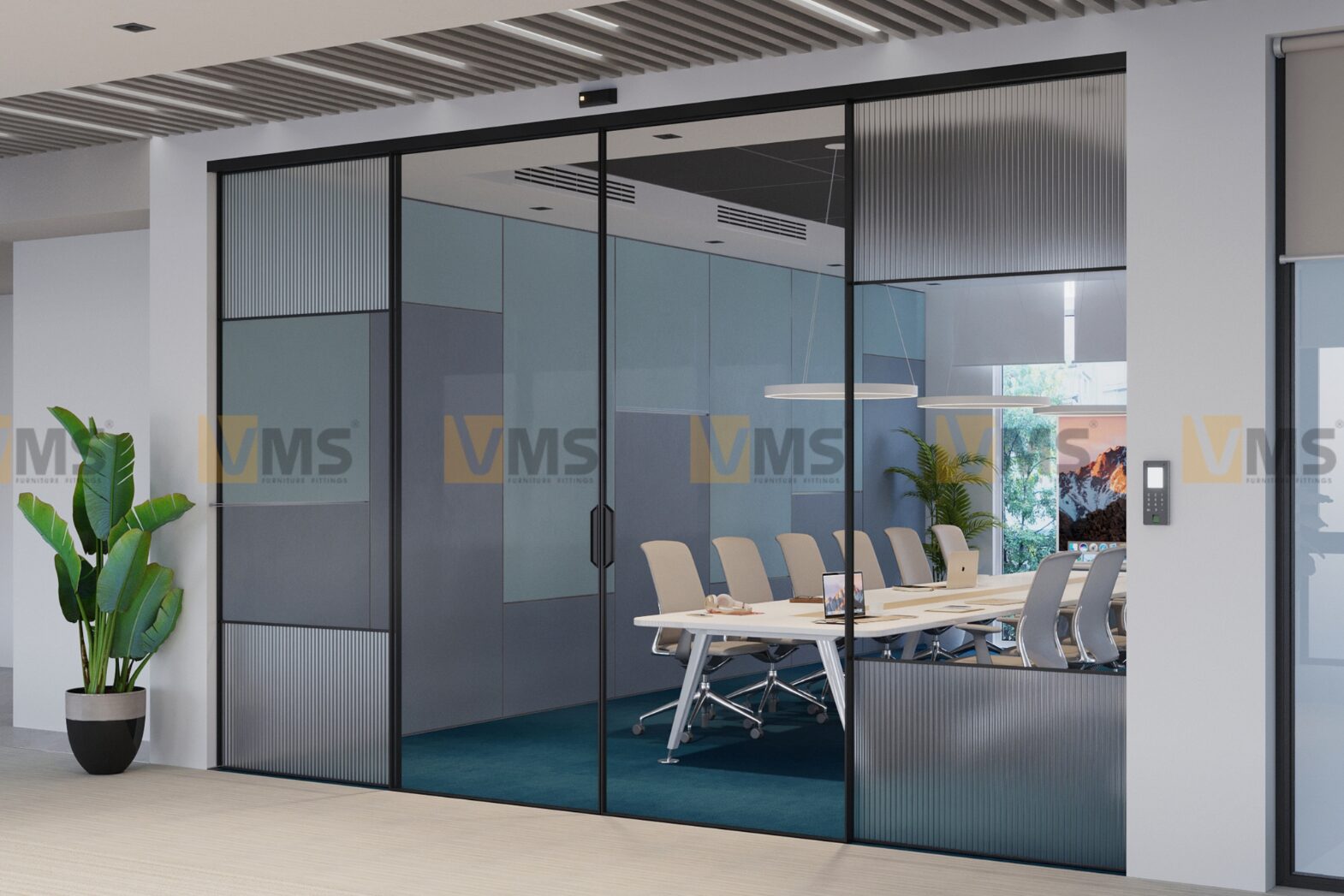

An automatic sliding door system opens and closes on a motor rather than by hand. With the VMS E-Motion system, a soft touch on a wall-mounted smart switch glides the panel open quietly, evenly, with no push, no pull and no slam at the end of travel. The door does the work, and it does it the same way every single time.
That last part is what separates a motorised system from a manual one. A hand-slid door moves as fast or as hard as the person pushing it. A motorised door moves on a controlled profile, so the motion is identical whether someone taps the switch on the way into a meeting or leans on it while carrying a laptop.
What is the VMS E-Motion sliding door system?
E-Motion is a motorised sliding door system for interior glass and framed partitions. Instead of a handle-and-track operation, the panel is driven by a concealed motor and operated through a smart switch mounted on the wall.
Press it once and the door slides open along its track. Press again, or let the system’s logic take over; it closes under control, easing into the frame instead of arriving with a bang. There is no manual effort, and none of the track rattle you get when a heavy glass panel is shoved by hand.
In a workspace, that matters more than it first appears. Cabin and conference-room doors are opened and closed constantly through the day, often by people mid-conversation or carrying things. A door that operates itself, cleanly and quietly, removes a small friction that repeats a hundred times a day.
Whisper-quiet motion, and why it matters in an office
Noise is the tell of cheap door hardware. A partition that thumps shut, or a track that grinds as the panel rolls, cuts straight across a quiet floor, and in an office, that interruption lands on everyone within earshot, not just the person at the door.
The E-Motion system is engineered for near-silent operation. The motor drives the panel smoothly through its full travel, and a soft-close action decelerates the door before it seats, so it closes fully without slamming. On an open office floor, in a boardroom mid-presentation, or outside a focused workspace, that quiet is not a luxury detail. It is the difference between a door that disrupts and one nobody notices, which is exactly what good hardware should be.
For meeting rooms, executive cabins and quiet zones, a door that closes without announcing itself protects the calm the partition was installed to create.
Where an automatic sliding door works best
Motorised sliding systems earn their place in specific situations rather than everywhere.
They suit large or heavy glass panels that are tiring to move by hand; the bigger the panel, the more the motor justifies itself, and office glass partitions tend to be large. They suit high-traffic doors used constantly through the day, such as conference rooms, cabins and reception dividers. They suit premium commercial interiors where the operation itself is part of the impression a space makes on clients and visitors.
They also suit accessibility. A touch-operated door is far easier for anyone carrying files, a laptop or a coffee than a heavy panel that has to be hauled across a track, and it supports a more inclusive workplace by design.
Where an automatic system is less essential: small, light doors that are rarely moved, or budget-led fit-outs where manual soft-close hardware already does the job well enough. Honest specification means matching the mechanism to the use, not fitting a motor everywhere. The same qualities also make E-Motion a fit for high-end residential projects, though the office is where it earns its keep hardest.
What sets a motorised system apart
The value of an automatic sliding door is not in any single feature; it is in how consistent the experience becomes.
A manual sliding door depends on the person using it. Some days it is nudged gently; other days it is shoved and left to rattle into the frame. A motorised system removes that variable. Every open is the same smooth glide, every close eases shut the same way, and the hardware behaves identically on day one and year five. For a partition that shapes how a workspace runs every day, that predictability is the point.
Combined with touch operation and near-silent motion, it turns a functional divider into part of the architecture, a door that works so cleanly people stop thinking about it.
Frequently asked questions
How does an automatic sliding door open?
A concealed motor drives the panel along its track. With the VMS E-Motion system, it is triggered by a soft touch on a wall-mounted smart switch.
Is a motorised sliding door noisy?
No. The E-Motion system is built for near-silent motion, with a soft-close action that eases the door shut rather than letting it slam.
Where is an automatic sliding door most useful?
Large or heavy glass partitions in high-traffic settings, conference rooms, executive cabins, reception dividers and quiet zones where constant, effortless, quiet operation matters.