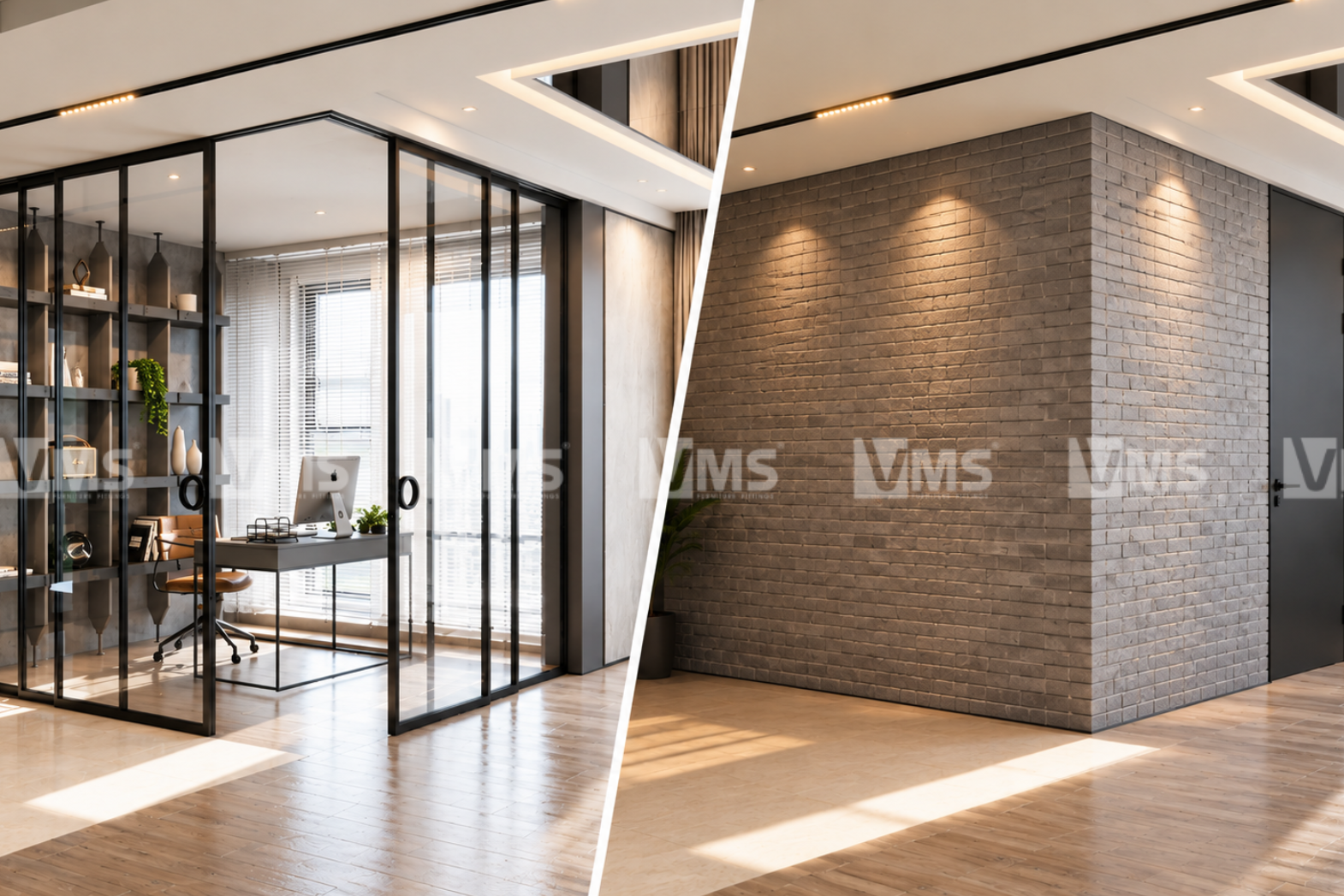

You’ve finally decided the living room needs a divider. Maybe it’s a study corner that keeps getting swallowed by the TV area, or a dining space that feels like it’s sitting in the middle of everything. Then comes the real question: do you call the mason and build a proper brick wall, or go with a sleek glass partition?
Both will split the room. What they do to the space, your timeline and your home’s future is very different.
Quick Answer
Choose a glass partition if you want to divide a space while keeping natural light, want installation done in days rather than weeks, and may want to change the layout later. Choose a brick wall if full soundproofing and complete visual privacy matter more than light and flexibility, such as in a bedroom or a home recording space.
Glass Partition vs Brick Wall: Side-by-Side Comparison
| Factor | Glass Partition | Brick Wall |
| Installation time | Usually 1–3 days | 1–3 weeks including plaster, curing and paint |
| Mess and dust | Minimal, dry installation | Heavy: cement, debris, repainting |
| Natural light | Flows through freely | Blocked completely |
| Soundproofing | Moderate, improves with thicker glass and well-sealed profiles | Excellent |
| Privacy | Adjustable with frosted, fluted or tinted glass | Complete |
| Weight on floor | Light | Heavy; may need structural checks on upper floors |
| Flexibility | Can be removed or relocated | Permanent; demolition needed to change |
| Look | Modern, open, premium | Traditional, solid |
| Maintenance | Regular glass cleaning | Repainting every few years |
1. Space and Light: Glass Keeps Rooms Feeling Bigger
A brick wall cuts a room in two. Once it’s up, one side often ends up darker and smaller than you pictured, especially in flats where only one wall has windows.
A glass partition divides the space without closing it off. Sunlight from the living room still reaches the study. The dining area still feels part of the home. For compact city apartments, this is often the deciding factor.
2. Installation: Days vs Weeks
A brick wall is construction work. Bricks, cement, plastering, curing time, then putty and paint. Your home becomes a site, and furniture needs to be covered or moved for weeks.
A glass partition built on a slim aluminium profile system is mostly a dry installation. The profiles and hardware are fixed, your fabricator fits the glass, and the space is usable almost immediately. If you’re planning a makeover before a festival or a family function, this time difference matters.
3. Soundproofing: Here Brick Wins
Let’s be honest. If you need a truly quiet room, like a bedroom next to a busy living area or a home office for long video calls, a brick wall blocks sound better than a standard single glass partition.
Glass can close much of that gap, though. Thicker toughened glass helps, but what most people overlook is the frame. Gaps between the glass and the profile are where sound leaks through. A well-engineered profile system with proper sealing makes a noticeable difference. For everyday conversation and TV noise, a well-built glass partition works well. For complete silence, brick still leads.
4. Privacy: Glass Gives You Options
Clear glass isn’t your only choice. Your fabricator can fit frosted glass that blurs everything behind it while still letting light through, fluted glass that adds texture and hides clutter, or tinted and smoked glass for a moody, premium look. You can even mix clear panels on top with frosted panels below.
Pair that with the right profile finish, like matte black, champagne or gold, and the partition becomes a design feature, not just a divider.
A brick wall gives total privacy, but that’s the only setting it has.
5. Flexibility: The Future-You Factor
Your needs will change. The study might become a kid’s room. The office might expand. With a brick wall, any change means breaking, dust and rebuilding.
Glass partitions with aluminium frames can be dismantled and reinstalled in a new layout. For rented homes and growing offices, this flexibility alone can make glass the smarter choice.
6. Weight and Structure
Brick walls are heavy. On upper floors, adding a new wall where the builder didn’t plan one may need a structural engineer’s approval, since the extra load sits on the floor slab.
Glass partitions are much lighter and usually don’t raise these concerns, which makes them easier to add in apartments and commercial floors.
Which One Is Right for Your Space?
Choose a glass partition for:
- Living and dining separation
- Home study or work corners
- Office cabins and conference rooms
- Kitchen-to-hall dividers
- Rented homes where you can’t do civil work
Choose a brick wall for:
- Bedrooms needing full privacy
- Home theatres or recording rooms
- Spaces where sound insulation is critical
- Load-bearing or exterior walls, where glass isn’t meant to replace structure
The Part Most People Forget: The Frame and Fittings
When people picture a glass partition, they picture the glass. But the glass is only half the story. The aluminium profiles and hardware decide how slim the frame looks, how smoothly a sliding panel moves, how well the edges are sealed, and how the partition holds up after years of daily use.
A thick, bulky frame can make even the best glass look cheap. A slim, well-finished profile lets the glass take centre stage while keeping everything secure and aligned.
The VMS Plus Slim Series offers aluminium profile systems for sliding, telescopic, pocket and openable partitions, in finishes designed to match modern Indian interiors. VMS Plus also offers customised frames for any type of glass, so whether your fabricator fits clear, frosted, fluted or tinted glass, the frame is made to suit it.
Frequently Asked Questions
1. Is a glass partition strong enough for home use?
Yes, when built with toughened safety glass and a sturdy profile system. Toughened glass is several times stronger than regular glass, and if it breaks, it shatters into small, blunt pieces rather than sharp shards.
2. Can a glass partition be soundproof?
It can reduce sound significantly, especially with thicker glass and well-sealed profiles. For complete soundproofing, a brick wall still performs better.
3. Does a glass partition give privacy?
Yes, with frosted, fluted, tinted or smoked glass. You can also use a mix of clear and frosted panels.
4. How long does it take to install a glass partition?
Most residential glass partitions are installed in 1–3 days, depending on size and design. A brick wall usually takes 1–3 weeks including finishing.
5. Can I remove a glass partition later?
Yes. Aluminium-framed glass partitions can be dismantled and reinstalled elsewhere, unlike brick walls, which need demolition.
6. Does VMS Plus supply the glass for partitions?
No. VMS Plus supplies the aluminium profile systems, hardware and customised frames. The glass is sourced and installed by your local fabricator or dealer, so you can choose the glass type, thickness and finish that suits your space.
Final Thoughts
A brick wall builds a boundary. A glass partition designs one. If your priority is light, speed and a layout that can grow with you, glass is the better choice. If total silence and complete privacy come first, stick with brick.
Still deciding? Connect with your nearest authorised VMS Plus dealer to explore the complete range of profile systems and finishes. With VMS Plus technical support behind every installation, you get a frame made for your glass and a partition built to last.