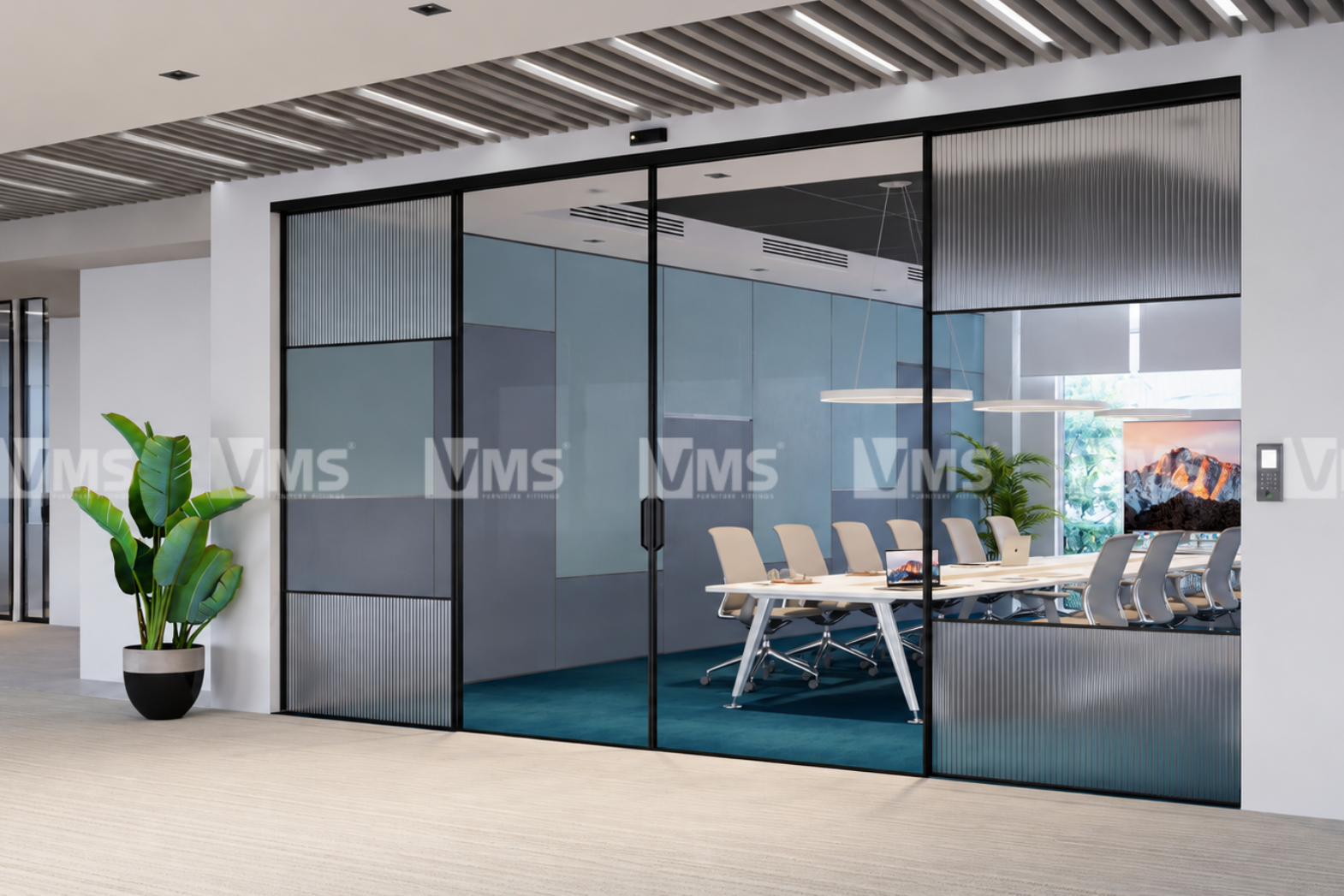

You’ve got the office space. Maybe it’s 600 sq ft in a commercial complex, maybe a little more. Now you need a cabin for yourself, a room for client meetings, maybe a corner for accounts, and still enough open area for the team to breathe.
Brick walls will eat up your floor and your light. Glass partitions feel like the obvious answer. But not every glass cabin works. Get the layout wrong and you end up with a boss’s cabin where everyone can hear every call, or a meeting room nobody wants to use.
Here are the small office cabin layouts that actually work, and how to get the glass, doors and privacy right for each.
Quick Answer
For small offices, use frosted or half-frosted glass for manager and accounts cabins, clear glass with a frosted band for meeting rooms, and sliding doors wherever space is tight. Keep private cabins against solid walls where possible, and use slim aluminium profiles to keep the office feeling open and bright.
Small Office Cabin Layouts at a Glance
| Layout | Typical Size | Best Door | Glass Treatment | Best For |
| Single manager cabin | Around 8×10 ft | Sliding or openable | Frosted or half-frosted | Owner, director |
| Shared two-person cabin | Around 10×10 ft | Sliding | Half-frosted | Partners, accounts, HR |
| Small meeting room | Around 10×12 ft (4–6 seats) | Openable or sliding | Clear with frosted band | Client and team meetings |
| Corner cabin | Varies | Sliding | Frosted on office side | Senior staff with window light |
| Focus room / phone booth | Around 5×6 ft | Openable | Frosted | Calls, focused work |
| Row of cabins | Repeating modules | Sliding | Consistent across all | Growing teams |
1. The Single Manager Cabin
This is the most common cabin in any small office. The mistake most people make is going full clear glass because it looks modern. Then every phone call, every private conversation and every document on the desk is on display.
What works better: frosted or half-frosted glass, clear on top for light and frosted from about waist to eye height for privacy. You stay connected to the team without being watched all day.
Place the cabin against an existing solid wall or window where possible. You get more privacy and natural light, and you need fewer partition panels.
2. The Shared Two-Person Cabin
Ideal for partners, accounts or HR. A half-frosted partition keeps it private enough for sensitive work while still letting daylight into the main office.
A sliding door works best here. It saves the swing space an openable door needs, which in a 10×10 room means an extra chair or a filing cabinet.
3. The Small Meeting Room
Meeting rooms need to feel open and welcoming, so clear glass works well. But add a frosted band at eye level. It gives a little privacy, looks professional, and prevents people from walking into the glass, which happens more often than you’d think.
For a room that sometimes needs to merge with the open office, consider a telescopic sliding door. It opens up a wide section of the wall for town halls or team events.
4. The Corner Cabin
A corner cabin with two outside windows is the best seat in the office. Use frosted glass only on the side facing the office and let the windows do the rest. You get a bright, private cabin without blocking light for everyone else.
5. The Focus Room or Phone Booth
In open offices, the loudest problem is always calls. A small frosted glass booth, just enough for one chair and a small desk, gives the team a place to take calls and focus without booking the meeting room.
6. A Row of Cabins for Growing Teams
If you need three or four cabins, line them up along one wall using the same glass and frame design. It looks organised, uses fewer materials, and makes future changes easy. Glass partitions can be dismantled and reconfigured as your team grows.
Sliding or Openable Door: Which Should You Choose?
| Factor | Sliding Door | Openable Door |
| Space needed | None beyond the panel | Needs swing space |
| Best for | Small cabins, tight corridors | Meeting rooms, focus rooms |
| Sound sealing | Good | Slightly better |
| Feel | Modern, space-saving | Classic, solid |
In small offices, sliding doors usually win. Use openable doors where sound sealing matters more than space, such as meeting rooms and phone booths.
Common Mistakes to Avoid
- All clear glass everywhere: privacy and noise both suffer.
- No frosted band on clear panels: people walk into it, and it feels exposed.
- Ignoring door swing: an openable door in a tiny cabin wastes usable space.
- Mixing frame styles: different profiles and finishes across cabins make the office look patchy.
- Forgetting sound: gaps between glass, frame and floor let conversation leak. The frame and seals matter as much as the glass.
The Frame Holds It All Together
In an office, partitions are opened, closed and leaned on hundreds of times a day. The aluminium profile decides how slim the cabin looks, how smoothly the doors move, how well the edges seal against noise, and how the whole system holds up over years of daily use.
Slim profiles in a consistent finish make even a small office look premium and well planned. Matte black gives a sharp corporate look, while champagne or silver keeps things light and neutral.
The VMS Plus Office Series offers aluminium partition profiles and door systems for cabins, meeting rooms and office layouts. VMS Plus supplies the profiles and fittings. Your fabricator fits the clear, frosted or tinted glass that suits each space.
Frequently Asked Questions
What is a good size for a small office cabin?
A single manager cabin typically works well at around 8×10 ft, while a small meeting room for 4–6 people needs around 10×12 ft. Exact sizes depend on furniture and layout.
How do I get privacy in a glass office cabin?
Use frosted or half-frosted glass, or add a frosted band at eye level on clear glass. Placing private cabins against solid walls also helps.
Are glass cabins soundproof?
Not fully, but they reduce noise significantly when built with thicker glass and well-sealed profiles and doors. For confidential rooms, openable doors seal slightly better than sliding ones.
Which door is better for a small office cabin?
Sliding doors save space and suit most small cabins. Openable doors are better where sound sealing matters most, like meeting rooms and phone booths.
Can office glass partitions be moved later?
Yes. Aluminium-framed glass partitions can be dismantled and reconfigured as your office grows, without demolition.
Does VMS Plus supply the glass for office partitions?
No. VMS Plus supplies the aluminium partition profiles, door systems and fittings. The glass is sourced and fitted by your local fabricator or dealer.
Final Thoughts
A small office doesn’t need more walls. It needs the right ones. Plan each cabin around what happens inside it: privacy for managers and accounts, openness for meetings, quiet for calls. Keep the frames slim and consistent, and your office will feel bigger, brighter and more professional.
Planning your office layout? Connect with your nearest authorised VMS Plus dealer to explore office partition systems and finishes, backed by VMS Plus technical support.