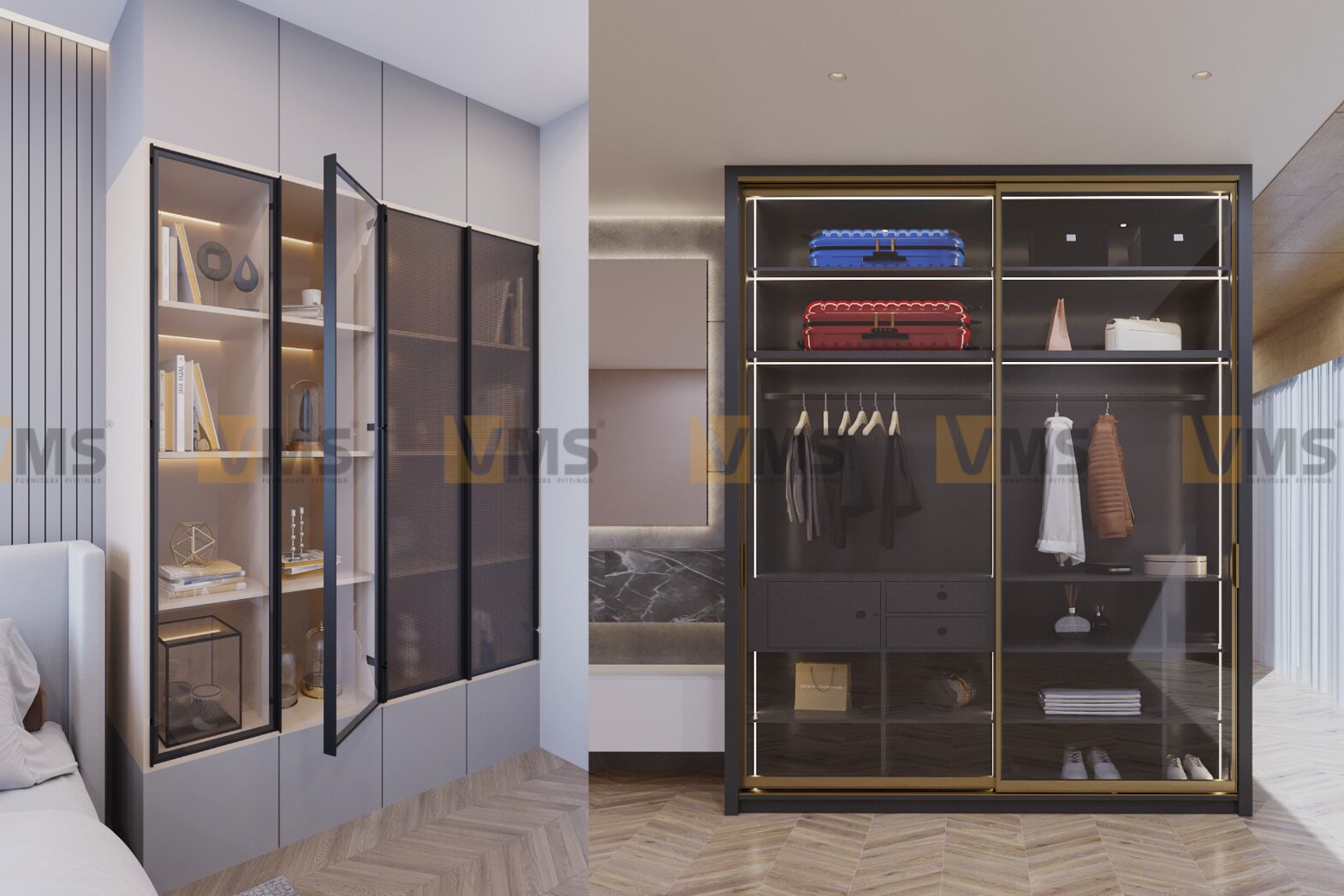

In short, the best approach would be to have a sliding wardrobe in cases where space on the floor in front of the wardrobe is limited and a hinged wardrobe if one needs to have a complete overview of the whole wardrobe. Sliding wardrobes save space due to the lack of swing into the room, while hinged wardrobes ensure access to everything inside.
However, such an answer does not help much, so here is how to decide in real-life situations.
Differences between sliding and hinged wardrobes
In a hinged wardrobe, the doors open outwards on hinges, similar to a cupboard, where the doors can swing freely. In a sliding wardrobe, the doors are made to move on tracks and slide past each other.
This difference in mechanics alone determines everything – from space requirements to accessibility, appearance, and usually price as well. Neither one is automatically better than the other; it all depends on what your needs are.
Space: the deciding factor for most people
This is where the choice is usually made.
A hinged door needs clearance in front of it to open. A standard door leaf swings out around 500 to 600 mm, which means you need that much empty floor between the wardrobe and whatever sits opposite – a bed, a dresser, a wall. In a compact bedroom, that clearance is often exactly what you do not have.
A sliding door needs no swing space at all. The panels move within the width of the wardrobe itself, so you can place a bed right up against it. For narrow rooms, box rooms and any layout where the wardrobe faces the bed closely, sliding doors solve a problem hinged doors create.
The trade-off: a sliding wardrobe can only ever open half its width at a time, because one panel has to sit behind another. A hinged wardrobe can open completely.
Access: seeing everything at once
Open a hinged wardrobe and the whole interior is in front of you – every shelf, every hanging rail, both back corners. Nothing is hidden. For people who like to see their full wardrobe while getting dressed, this matters more than they expect.
A sliding wardrobe always keeps part of the interior covered. To reach the left side, you slide the panel left; to reach the right, you slide it back. It works perfectly well day to day, but you never see the entire wardrobe in one view, and the section directly behind a stationary panel is slightly harder to reach.
If your wardrobe holds a lot and you access all of it often, hinged wins on convenience. If you mostly reach for the same few sections, sliding is no real compromise.
Look and feel
Sliding wardrobes read as clean, modern and flush. The doors sit in one plane, no handles are projecting into the room, and large glass or laminate panels create an uninterrupted surface. This suits minimal, contemporary interiors.
Hinged wardrobes offer more variety in styling – panel detailing, handle choices, and the option of a taller, more traditional cupboard look. They also allow full-height internal fittings without a central track dividing the space.
Both can look premium. The question is whether you want the seamless flat face of a slider or the flexibility and full-open access of a hinged design.
Cost and maintenance, briefly
Sliding systems carry more hardware – tracks, rollers, guides – so they often cost a little more and depend on that hardware running smoothly. A quality track glides for years; a cheap one collects grit and drags. Hinged wardrobes are mechanically simpler, with hinges as the main moving part, and are generally easier and cheaper to service.
In both cases the hardware quality matters more than the door type. A good hinge or a good track lasts; a poor one is where problems begin.
Choose this if…
Choose sliding wardrobes if:
- Your bedroom is compact or the wardrobe faces the bed closely
- You want a flush, handle-free, modern look
- You do not need to see the whole wardrobe at once
Choose hinged wardrobes if:
- You have clear floor space in front of the wardrobe
- You want full access to the entire interior in one view
- You prefer simpler hardware and easier long-term servicing
Frequently asked questions
Which is better for a small bedroom, sliding or hinged?
Sliding, in most cases. Sliding doors need no swing space, so they suit rooms where a bed or furniture sits close to the wardrobe.
Do sliding wardrobes give less storage than hinged ones?
Storage capacity is similar. The difference is access – a sliding wardrobe only opens half its width at a time, while a hinged one opens fully.
Are sliding wardrobes harder to maintain?
They have more hardware, so track quality matters. A well-made sliding system runs smoothly for years; keeping the track clean is the main upkeep.