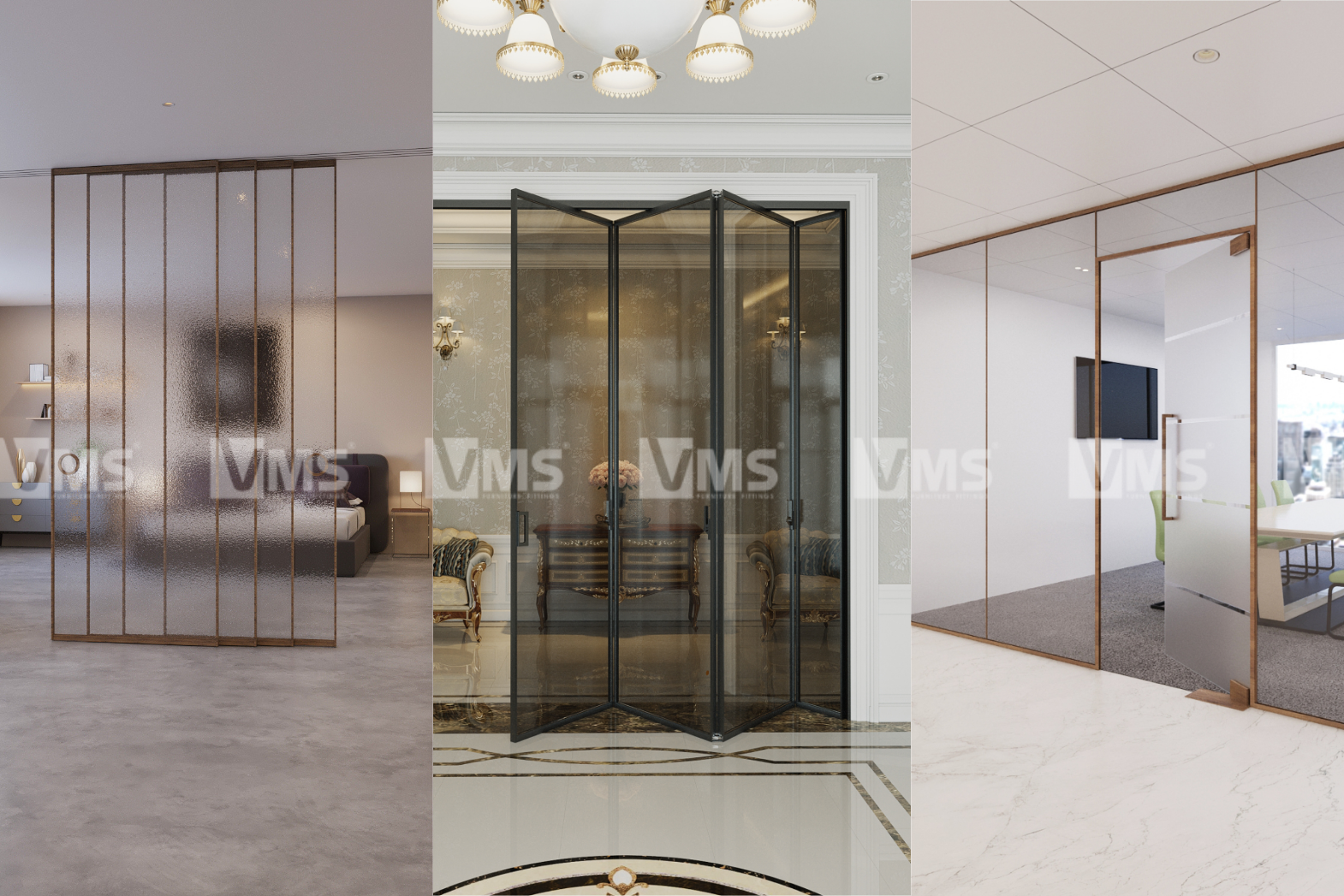

Walk into any modern office today and you’ll notice something missing — solid walls. Glass partition systems have quietly replaced them, and for good reason. They keep spaces bright, make small offices feel larger, and let teams stay visually connected without the noise.
But here’s where most people get stuck: sliding, openable, or pocket? All three look similar in a catalogue. In daily use, they behave very differently.
Quick answer: Sliding glass partitions suit offices that need flexible, space-saving dividers for meeting rooms and cabins. Openable glass partitions work best where full-width access and easy movement matter, like reception areas. Pocket glass partitions are ideal when you want the partition to disappear completely into the wall, creating one open space on demand.
Now let’s break down when each one actually makes sense.
Sliding Glass Partition Systems: The Space-Saver
A sliding glass partition moves along a top or bottom track, so the panels glide sideways instead of swinging open. No door clearance needed which is exactly why they’ve become the default choice for compact Indian offices where every square foot is accounted for.
Choose sliding partitions when:
- Floor space is limited and swing clearance isn’t available
- You’re dividing meeting rooms, manager cabins, or huddle spaces
- You want panels that can be partially opened for ventilation or interaction
- The layout changes often – telescopic and synchronised sliding systems let multiple panels stack neatly
One thing worth knowing: track and roller quality decides everything. A sliding partition with precision-engineered rollers glides silently for years; a budget system starts rattling within months. This is where hardware quality matters more than the glass itself.
Openable Glass Partition Systems: The Classic Choice
Openable (hinged) glass partitions work like traditional doors panels swing open on hinges, either individually or as a folding set. They’re the most familiar option and often the most practical one for high-traffic zones.
Choose openable partitions when:
- The area sees constant movement – reception, conference rooms, cafeteria entries
- You need the partition to open fully and quickly
- Accessibility matters – wheelchair users and trolleys pass through more easily
- You want better acoustic sealing, since hinged panels close firmly against gaskets
The trade-off? Swing clearance. Each panel needs free space to open, so furniture placement around an openable partition needs planning.
Pocket Glass Partition Systems: The Disappearing Act
A pocket glass partition slides completely into a cavity built inside the wall. Close it, and you have a private cabin. Open it, and the partition vanishes no visible panels, no stacked glass, just one seamless open space.
Choose pocket partitions when:
- You want a truly open-plan feel with the option of privacy on demand
- The design brief calls for a clean, minimal look with zero visible hardware
- You’re planning the layout from scratch pocket systems need wall cavities built during fit-out, not after
Pocket systems demand the most planning but deliver the most dramatic result. For premium offices, boardrooms, and client-facing spaces, nothing else comes close.
Side-by-Side Comparison
| Factor | Sliding | Openable | |
| Space required | Minimal | Swing clearance needed | Minimal (needs wall cavity) |
| Best for | Cabins, meeting rooms | Receptions, high-traffic areas | Boardrooms, open-plan offices |
| Acoustic sealing | Moderate | Best | Moderate |
| Installation stage | Anytime | Anytime | During fit-out only |
| Flexibility | High | Medium | Highest |
| Maintenance | Track cleaning | Hinge care | Track + cavity care |
So Which One Fits Your Office?
Match the system to how the space is actually used, not how it looks in a render. Busy access points need openable panels. Tight cabins need sliding systems. Spaces designed to transform need pocket partitions. Many well-planned offices combine all three sliding partitions for cabins, openable doors at entries, and a pocket system for the boardroom.
Whatever you choose, remember that the aluminium profiles, tracks, rollers, and hinges carry the entire system. and precision hardware are what separate a partition that works for a decade from one that fails in a year.
FAQ
- Which glass partition system is best for small offices?
Sliding glass partitions are best for small offices because they need no swing clearance. Panels glide along a track, saving floor space while still dividing cabins and meeting areas effectively.
2. Are pocket glass partitions expensive to install?
Pocket partitions involve more planning because the wall cavity must be built during fit-out. Installation is more involved than sliding or openable systems, which is why they suit new projects rather than retrofits.
3. Do glass partitions reduce noise in offices?
Yes. Toughened or laminated glass partitions with proper gaskets and sealing significantly reduce office noise. Openable systems with firm gasket closure generally offer the best acoustic sealing among the three types.
4. Can sliding and openable partitions be combined?
Absolutely. Many offices pair sliding partitions for cabins with openable doors at entry points. VMS Plus systems are designed to work together, so mixed layouts stay visually consistent.
Ready to Plan Your Office Partition Layout?
VMS Plus manufactures slim, telescopic, synchronised, openable, and pocket glass partition systems engineered for Indian commercial spaces trusted by architects, dealers, and interior designers.